

.png)
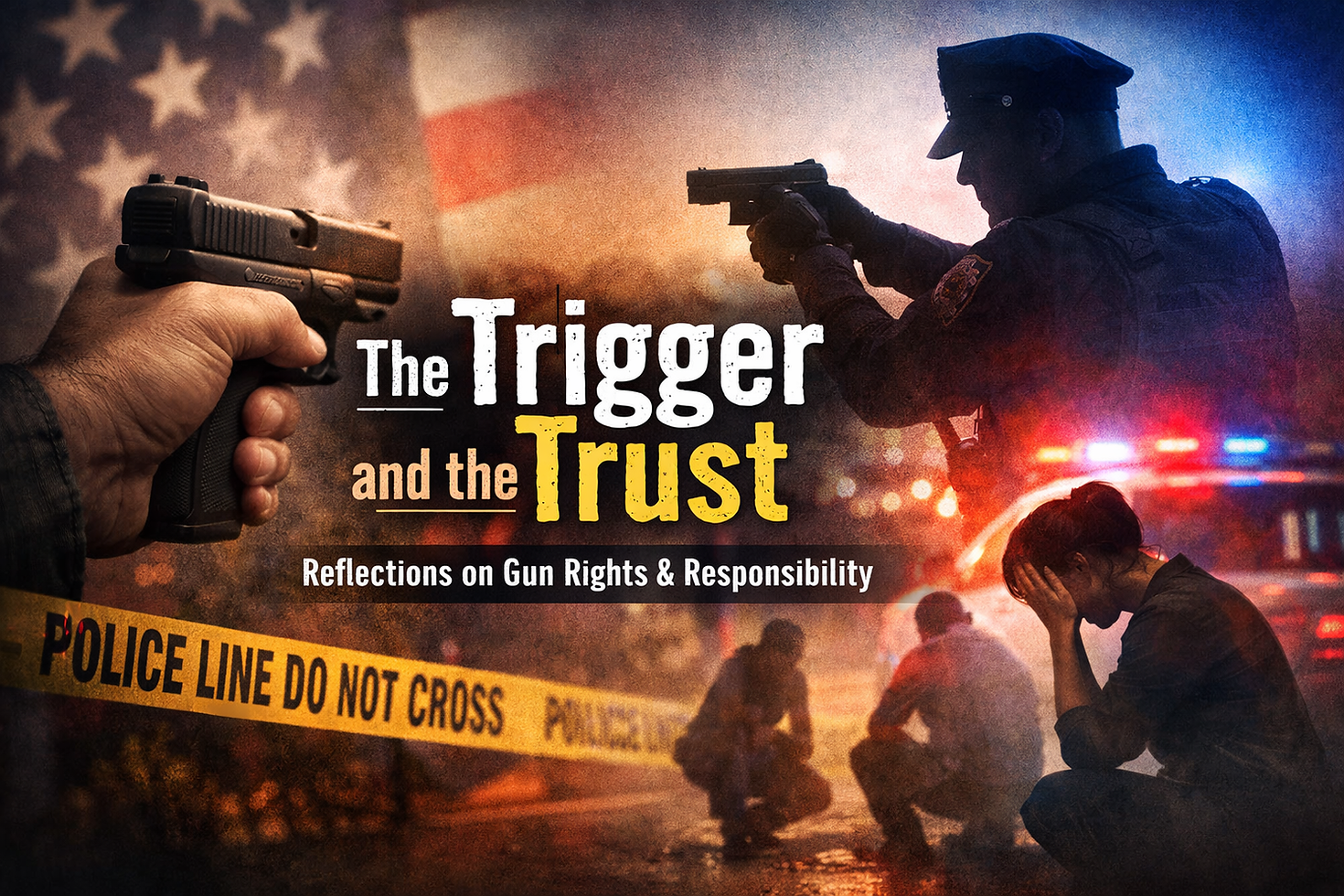
The Trigger and the Trust

There’s a powerful and necessary conversation we need to keep having about the intersection of our Second Amendment rights and the immense responsibility that comes with them. I believe deeply in the right to bear arms. I believe in personal liberty. I believe in lawful gun ownership. And at the same time, I am deeply concerned about the human being who makes the decision to pull the trigger.
Because a gun does not act on its own. A person does.
On July 4, 2021, I was shot. The person who pulled that trigger is the only one who knows his true reasoning in that moment. What I have come to understand over time is this: it was a snap decision. One moment. One choice. And in that fraction of a second, both of our lives were permanently altered. There was no undo button. No opportunity to re-evaluate once the shot was fired. That reality stays with you.
That lived experience shapes how I view every conversation about firearms—especially when they are used by those entrusted with public safety.
Just yesterday, I learned of a tragic officer-involved shooting in Minneapolis, where an unarmed woman lost her life. Incidents like this are complex, emotional, and often polarizing. Law enforcement officers are placed in extraordinarily difficult positions. They are supposed to be trained to assess threats quickly. They are authorized to use force when they believe lives are in danger. Society asks them to make decisions under pressure that most civilians will never face.
And yet, that does not remove the weight of the outcome.
What gives me pause—what truly concerns me—is not simply the unholstering of a firearm, but the permanence of its use. When an officer decides to fire, that decision cannot be reversed. A life is changed, or ended, forever. Families are shattered. Communities are shaken. Trust is strained. And even if an investigation later deems the action “justified,” the loss remains.
This is where the conversation must go deeper.
Officer-involved shootings force us to confront hard questions about training, stress response, fear perception, and de-escalation. Were there other options available? Was time on anyone’s side? Could distance, communication, or non-lethal tools have changed the outcome? These questions are not accusations—they are responsibilities. They are the questions we owe to the public, the families and to officers themselves.
Gun violence is devastating on our streets. But it carries an even heavier weight when lethal force is used by those sworn to protect. The badge represents authority, yes—but it also represents restraint, judgment, and trust. When that trust is broken, even unintentionally, the ripple effects reach far beyond the immediate incident.
I don’t write this from a place of anger. I write it from a place of concern. I know what it means to be on the receiving end of a split-second decision involving a firearm. I know what it means to live with the aftermath. And that is why I believe so strongly that the conversation about guns cannot stop at rights alone.
Rights must be paired with accountability. Power must be paired with discernment. Training must include not just tactics, but emotional regulation, threat assessment under stress, and de-escalation as a first response—not a last resort.
The Second Amendment is not the problem. The presence of firearms is not the whole story. The real issue—the one we must be brave enough to face—is the human factor. The moment when fear, stress, assumption, or impulse overrides pause and possibility.
Because once the trigger is pulled, trust—like life—cannot be restored the same way it was before.


